Director Vasily Bereza; script writer Pavel Shirov; producer Andrey Norkin, Pavel Shirov, Vasily Bereza; editors Vladimir Kara-Murza, Sergey Buneev, Alena Stepanenko, Viktor Kulganyuk, Tatiana Lobko, Aleksandr Orlov, Tatiana Adamyan

Production: TV company Echo
Length: 2 episodes, each 52 minutes
Where it was shown: RTVi; In Europe, USA (no details); Ukrainian TV – 5th Channel; Georgia, Lithuania, Poland, Latvia (2005); Some festivals, outside of the main contest

Film online Episode 1:

https://youtu.be/-_eUDo-T9R0

Episode 2:

https://youtu.be/toIZDw0I3fg

Personalities shown: Vladimir Putin, Mikhail Gorbachev, Boris Eltsin, Leonid Brezhnev, Pavel Grachev, Gennady Zyuganov, Anatoly Sobchak, Eugeny Primakov, Samir Saleh Abdullah (Ibn al-Khattab), Sergey Stepashin, Yuri Andropov, Patriarch Alexy II, Yury Skuratov


Characters: Aleksandr Yakovlev, Ruslan Aushev, Andrey Piontkovsky, Vladimir Gusinsky, Boris Nemtsov, Viktor Shenderovich, Evgeny Kiselev, Boris Berezovsky, Sergey Dorenko, Vitaly Korotich, Akhmed Zakaev, Georgy Satarov, Henry Reznik, Vladimir Bukovsky, Oleg Kalugin, Boris Vishnevsky.

According to one of the filmmakers, this film was banned in Russia. This might have happened because the filmmakers questioned the results of the 2003 Gosduma elections in the film. They chose to focus on Putin because the answers to the main questions always returned to him. And in a way, they kept trying to answer the question “Who is Mr. Putin?” Nobody knew about either Putin’s political views or his political program. It was an attempt to understand why an almost unknown person was elected as president in Russia in 2000 and re-elected in 2004 for a second term without question. In the first episode, they show Putin’s life from his graduation from university to his inauguration. In the second, they talk about his first presidential term.

The documentary was made by RTVI, a media outlet owned by Russian oligarch Vladimir Gusinsky. They filmed in Russia, the US, and Great Britain. It is a collection of archival videos and multiple interviews. One can notice that this documentary, which was made in the early 2000s, when compared with the documentaries about Putin from the 2010s and 2020s is not as smooth in editing and the quality of shooting, but the interviewers are more open and critical about important and often tragic events in Russia. The filmmakers tried to show different points of view. Berezovsky, Dorenko, Zakaev, and Kalugin represent a kind of opposition, while Vitaly Korotich (a former editor of “Ogonek”), Aleksandr Yakovlev, and Ruslan Aushev represent witnesses and Coicipants in historical events. Yakovlev talks about the return of Soviet symbols such as the flowers on Andropov’s tomb and the Stalinist era. Piontkovsky, Shenderovich, and Kiselev talk about the restrictions of freedom in the media and the case of NTV while Sergey Dorenko investigates the Kursk disaster and Putin’s reaction to it, and Aushev talks about the Nord-Ost terrorist attack.
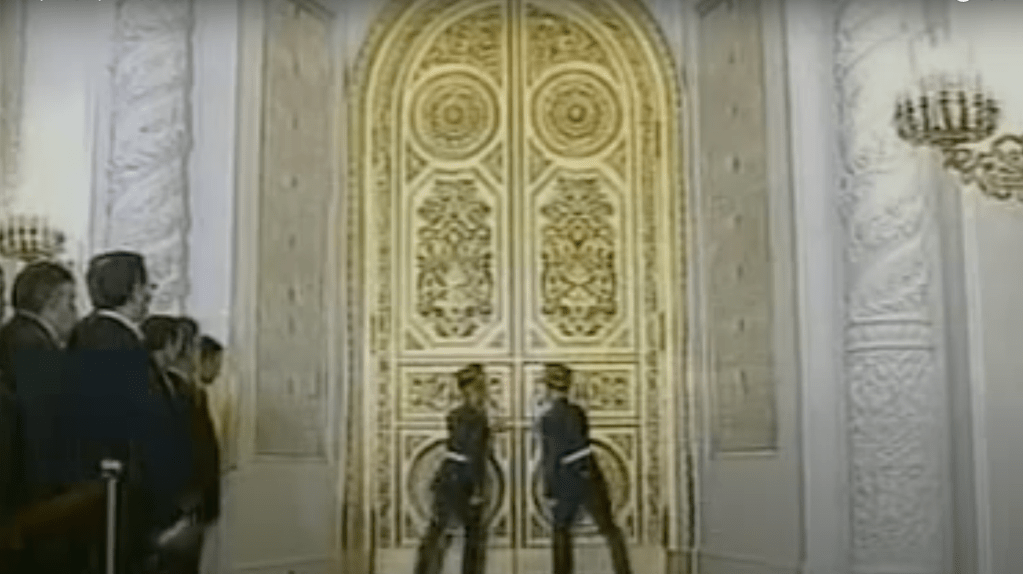
Comrade President (2004). Guards are opening doors in front of Putin.
Comrade President (2004). Guards are opening doors in front of Putin

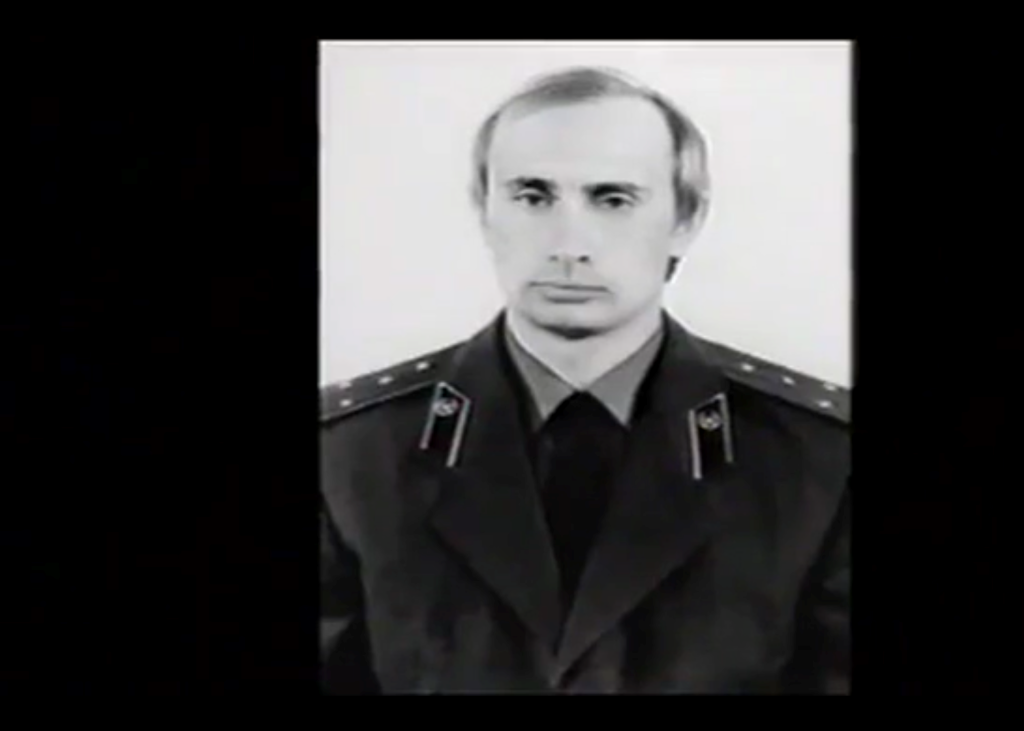
A voiceover presents the pre-presidential years of Putin’s life through archival videos and interviews. Interestingly, the filmmakers decided not to use the ‘standard’ photos from Putin’s family album.  Instead, they focus on Putin’s career. They analyse the role of the KGB in the life of the future President and in the country in general. A special interest is shown towards Putin’s return to Russia from Germany and the development of his career: how he left his work at the university and became a bureaucrat.

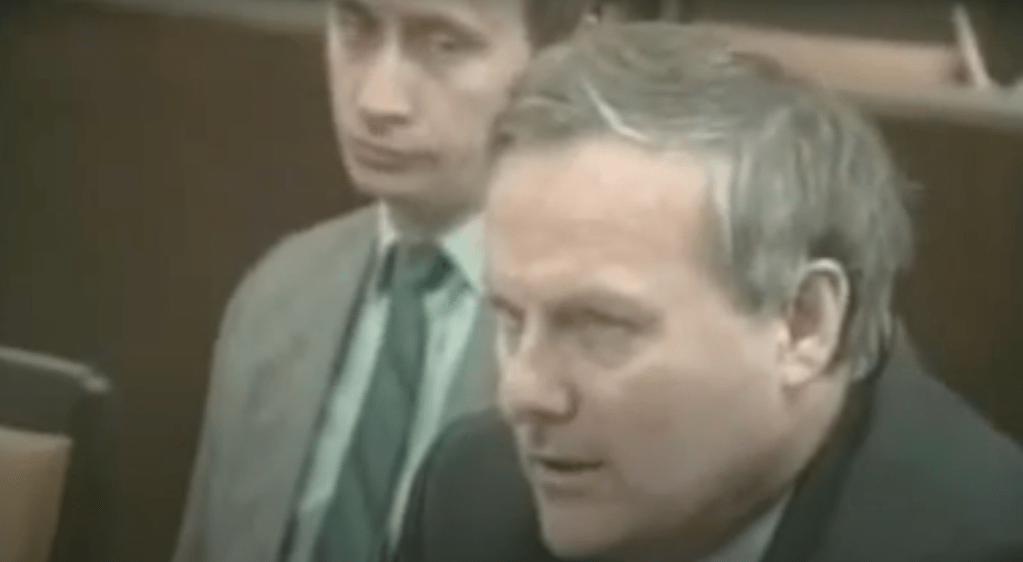
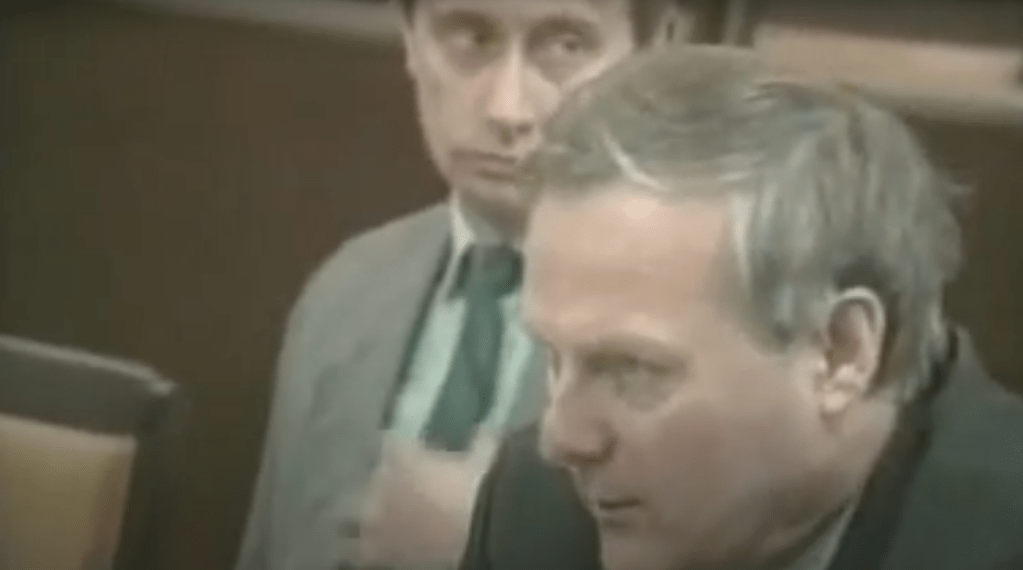
Comrade President (2004). Anatoly Sobchak and his assistant Vladimir Putin

Filmmakers also emphasize Putin’s activities regarding the fight against terrorism and the war in Chechnya.

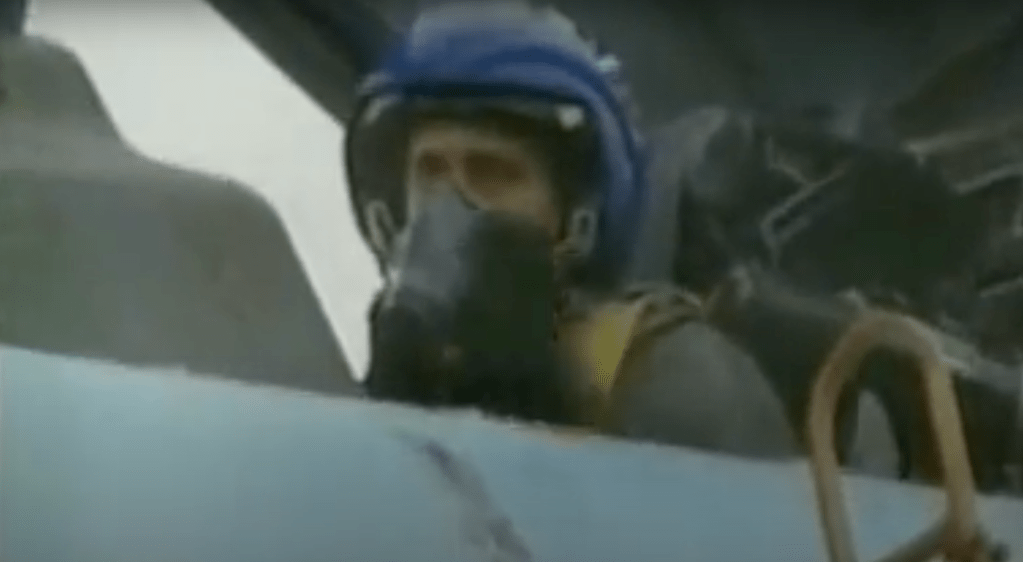
Comrade President (2004). Putin is outing on the uniform for a military jet to go to Chechnya.

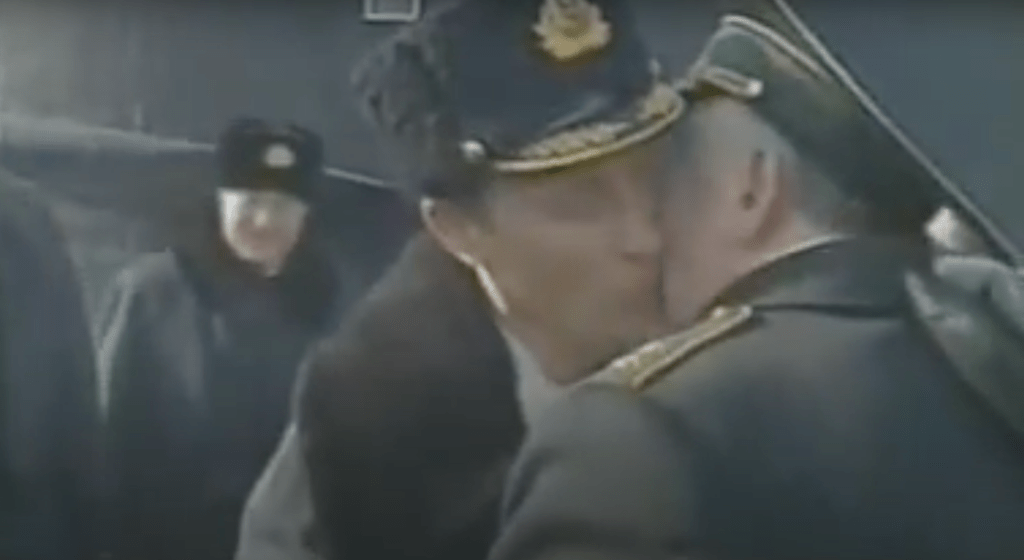
Comrade President (2004). Putin in military uniform is greeting another person in the uniform.

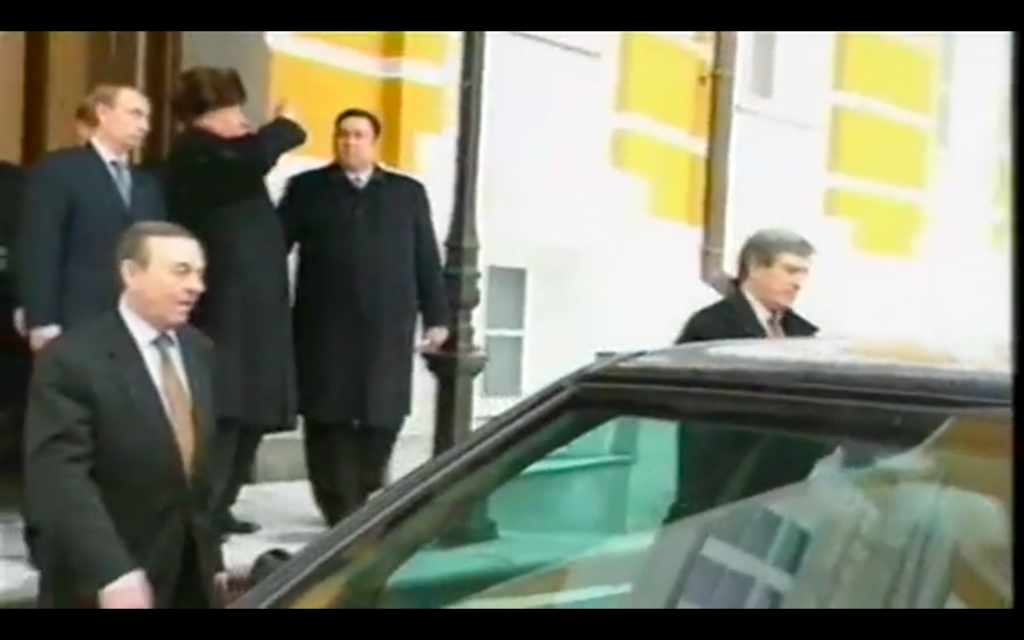
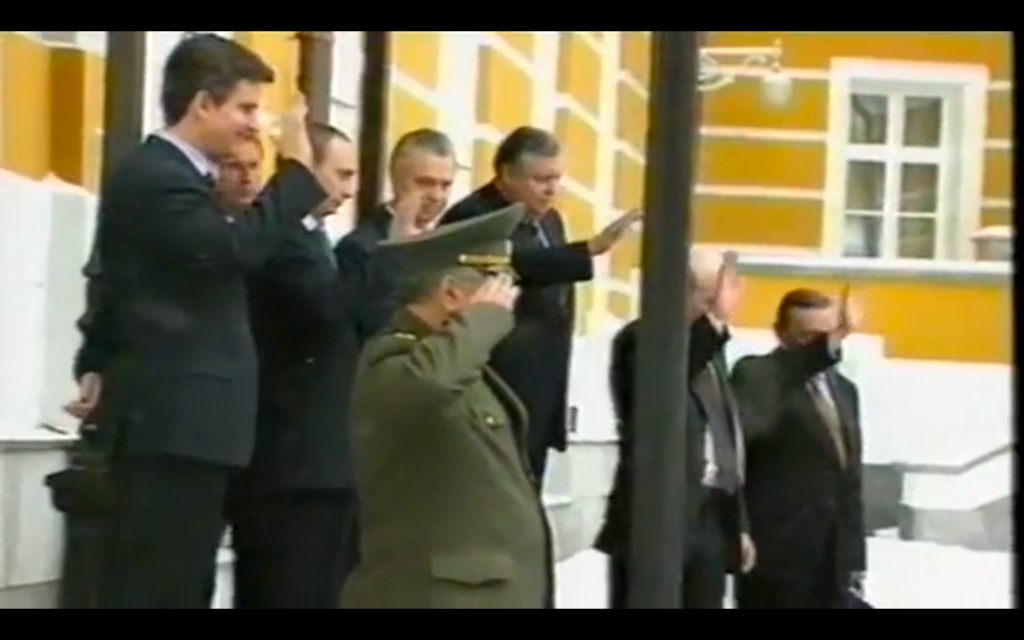
The episode where ELtsin leaves the Kremlin is quite emotional. Putin’s inner circle follows both presidents: the new and the old. Boris Eltsin, though he seems to be more emotional, opens the door for Putin, hugs him and leaves the Kremlin.

Comrade President (2004). Eltsin’s farewell.

Episode 2.

The second episode tells stories about Putin as a president. Starting from his inauguration and continuing through his fight with the oligarchs; scandal with Yury Skuratov, the Prosecutor General of Russia (1995-1999) and the Kursk tragedy.

Comrade President (2004). Presidential inauguration. Putin is walking on the red carpet.
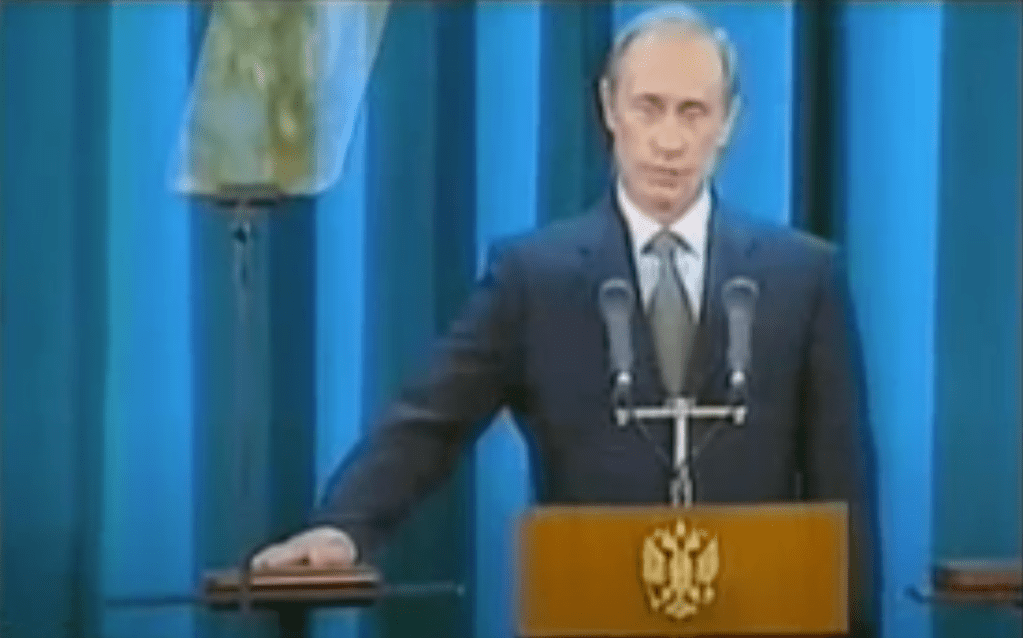
Comrade President (2004). Presidential inauguration. Putin and Constitution.

Comrade President (2004). Putin on CNN says that the submarine drowned. He is smiling.

Sergey Dorenko, (TV journalist):

In the absence of society, we become telenation. How can I be involved in what Putin is doing? I can only go and turn on the TV. This means that I only observe the TV president. I have no other president. I only have Teleputin. And so, it is with each of us. And this Teleputin is interesting – we like him, he gives a feeling of peace.

Andrey Piontkovsky (political scientist):
Let’s be objective. Putin is a sincere patriot of Russia. But he is sincerely convinced that the future of Russia, its modernization can be conditioned by the tough means of authoritarian rule.

Sources:

1. Umetsky, D. (2004) Novie izvestiya. Telezvezda na eksport. Interview with Andrey Norkin.

2. Vilegzhanin, R. (2004) Moskovskie novosti. Prezident tebe tovarisch. Interview with Pavel Shirov and Vasily Bereza.

3. Afanasieva, E (2005) Ekho Moskvi. Novosti, kotorih ne vidyat v Rossii. Interview with Andrey Norkin.

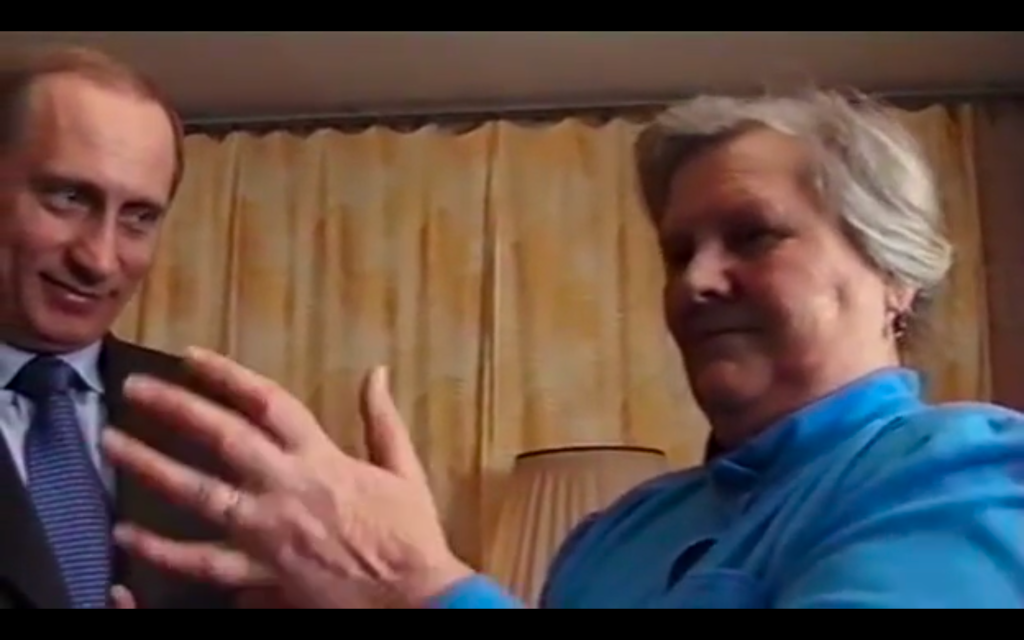
Uknown Putin. Peace and War.2000. Vladimir Putin is drinking milk in his jet.

Director Sergey Miroshnichenko,

Scriptwriter Vitaly Mansky,

Producer Sergey Miroshnichenko,

Composer Alexander Sidelnikov

Production: Studio Ostrov

Length: 55 minutes

Where it was shown: TV Channel RTR (Russia), Leipzig Film festival (Germany), New York (USA)

Personalities shown: Tony Blair, Sergey Ivanov, Mikhail Shvydkoi, Ilya Klebanov, Valentina Matvienko, Dmitry Kozak, Leonid Reiman, Gleb Pavlovsky, Vladislav Surkov, Boris Eltsin

Characters: Vera Gurevich, Vladimir Putin

Film online (8 min. episode):

This documentary was one of the first films devoted to Vladimir Putin. The film director, Sergey Miroshnichenko, is still one of the most prominent documentary film directors in Russia. Vitaly Mansky, who had worked for state-owned television in Russia, was the scriptwriter for this film. Later, he established the documentary film festival Artdocfest. This festival had to migrate from Russia to Latvia due to political pressure.

One year after Unknown Putin. Peace and War [Neizvestny Putin. Mir I Voina]  (2000) Mansky made Putin. The Leap Year [Putin. Visokosny god] (2001) included material from the earlier film and presented the results of Putin’s first year of presidency. In 2018 Mansky also made Putin’s witnesses [Svideteli Putina] (2008), which likewise uses material from the two previous films.

This film about Vladimir Putin is the first one about Putin as the president of the Russian Federation. This starting point shows that Putin is already quite a closed political figure. There are different famous personalities in the film, but they do not speak. A certain level of intimacy is created via interviews with the main character Vladimir Putin. He is the one with the voice, and, as an exception, his schoolteacher in a secondary school, Vera Gurevich who is also at the very beginning of her public role as ‘a teacher of the president’ and a guide to Vladimir Putin’s biography.

With the notable exception of Power [Vlast´]  (1992), this is the first audiovisual evidence of the personality of Putin in the beginning of his career as the highest official in the state. The situation in the country at that moment was shown as tense: terrorist explosions, the war in Chechnya, the struggle for the preservation of national heritage. Vladimir Putin is in the focus. Already in this film, there is only one masculine figure. All the females-like his mother, wife, and daughters-are on the sidelines and shown in photos. His wife, as well as Valentina Matvienko, a Deputy Prime Minister of Russia for Russian Welfare, also appear in an archival video from an official visit with Tony Blair. The documentary starts and ends with the scenes of Putin’s visit to his schoolteacher, Vera Gurevich (later on she will appear in some other documentaries about Putin and will also write a book about him). Already in this film, Putin is presented as a self-sufficient man whose mother/teacher figures and the other women in his life are background support.

Many of the following features will become a trademark for the films about Vladimir Putin, regardless of the personality of the film directors, their nationalities, and even their opinions of Putin.

Among those features is a “unique”—repeated almost in every film—visit to the President’s office in the Kremlin. In Unknown Putin. Peace and War, Mansky visits Putin’s office and asks him whether the president has had a look from the windows in his office. Putin literally looks behind the curtain under the supervision of a camera. All the equipment in the office is left from his predecessor, Boris Eltsin. Putin admits that the computer is his own and he is still learning how to use it.


The time and space of filming Vladimir Putin are often replicated across different films about the president. The interviews are held in the same locations: different rooms in the Kremlin, his office, the president’s residence in Sochi, the president’s airplane, his car. Sports locations: a swimming pool, an ice skating rink, a tatami. Interviews are conducted en route to some other place, in the breaks between meetings, late evenings, even at night. Mansky films Putin in his office in the Kremlin, in his residence near Moscow, in his car. They also show some protests in Moscow, where Putin is not only present but also talking to one of the activists about saving an architectural monument. This latest scene is almost impossible to imagine nowadays.

There is plenty of footage of sorrow and grief that was on the internal political agenda in those days. Mansky filmed Putin’s late-night visits to the monument commemorating the victims who died in the terrorist attacks on Gurianova street in Moscow. The filmmakers included a long piece of footage of the public funerals of the paratroopers (who were killed in Chechnya) at the Pskov Kremlin.

The personal story of Putin is told through photos. These photos, as well as biographical stories, travel from one film to another. From  Unknown Putin. Peace and War we learn some of them: how his mother won their first car in the lottery, how he met his wife Ludmila, about the fire that once happened at his dacha, and how he saved his secretary and his daughter from the fire and others.

Some archival photos from the film:

Meanwhile, the history of the country is told through archival video. Symbolically rich is the episode with Boris Eltsin and his departure where Putin and some other politicians close to him are saying goodbye to Eltsin on the porch in the Kremlin.

The authors of this documentary would rather observe Vladimir Putin than attempt to explain things. The latter happens with many of the films about the president. Here, in contrast, only three people do most of the speaking: Putin, Mansky, and Vera Gurevich. Thus, we do not learn much about the president: he likes tea with milk, he used to call his wife when he was going to be late at work, he works out every day, and he is very busy and works until very late.


The observational mode of the film leaves us an opportunity to see an early representation of Vladimir Putin as the president of Russia. As Mansky will explain later (see Putin The Leap Year), he saw Putin as a person who was not used to being on the front page and preferred staying backstage. That is why Mansky jokes that he will give commands to Putin: the director tells Putin where and how to pose in front of the camera. As a result, footage, where photographers ask Putin to pose in front of the camera, creates a very vivid image of a young politician on the new stage of his career as a public figure. Recent documentaries never allowed these kinds of ´liberties´, where Putin is said what he is supposed to do.

Quote from the film:

– Have you settled into the Kremlin?
– Yes, I have!
– How do you like it?
It is comfortable!
– Comfortable? And what about the president’s armchair? How is it?
It fits!

vladimir putin

Sources:

1. Interview Z. Svetova with V. Mansky for OpenRussia (2017)

2. Karpenko, M. Filmography of Vladimir Putin. Kommersant. 2018

3. Interview A. Artukh with V. Mansky for Artterritory (2013)