Director Vitaly Mansky; cameramen Yuryi Ermolin, Vyacheslav Sachkov, Alexandr Kuznetsov, Eugeny Sveshnikov, Pavel Sukhov, Sergey Miroshnichenko, Igor Muraviev, Sergey Shishkin, Vitaly Mansky; sound director Lidiya Scherbakova, Alexandr Veselkin; producer Natalia Manskaya

Production: Studio “Vertov &K” ordered by TV Channel RTR
Length: 55 min
Where it was shown: TV Channel RTR (Russia)

Personalities shown: Ludmila Putina, Tony Blair, Maya Plisetskya, Bill Clinton, Gerhard Schroder, Yury Luzhkov, Alexander Lukashenko, Nursultan Nazarbaev, Sergei Shoigu, Patriarch Alexy II, etc.
Characters: Vera Gurevich, Vladimir Putin

Film online (4 minutes):

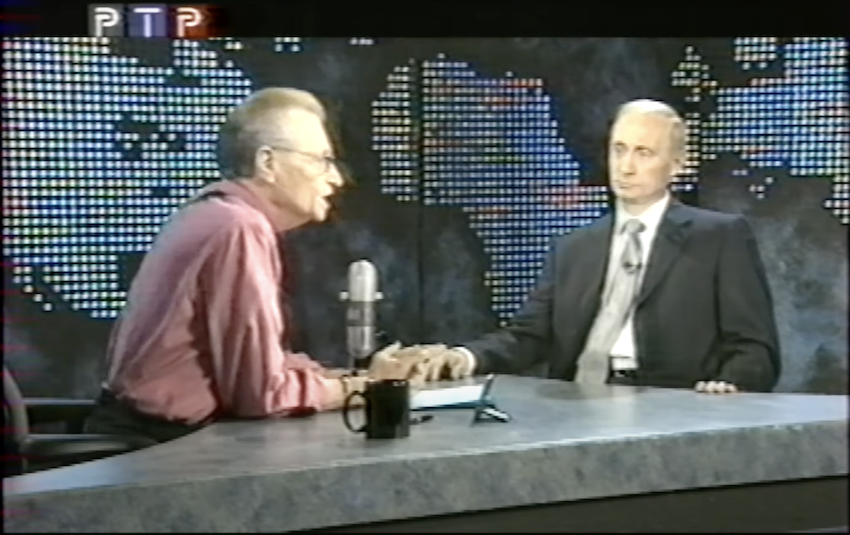
Excerpt from Putin. The Leap Year (2001).

Putin. The Leap Year [Putin. Visokosny god] was made by Vitaly Mansky with footage from the first year of Putin’s presidency (starting from his first days in the Kremlin when he became the Acting President until May 7th, 2001, the 1st anniversary of his official presidency). It includes some material from Unknown Putin. Peace and War [Neizvestny Putin. Mir I Voina]  (2000). Mansky comments on some of the footage. In 2018, Mansky made another film, Putin’s Witnesses [Svideteli Putina] (2018), where he also uses video from the two earlier films.

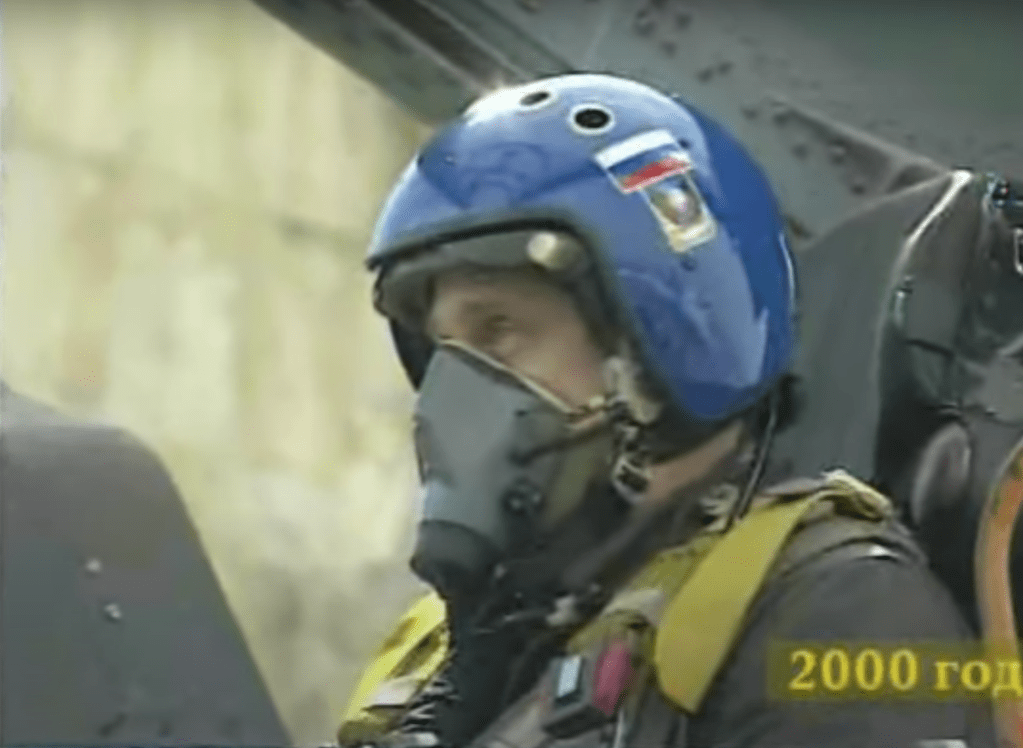
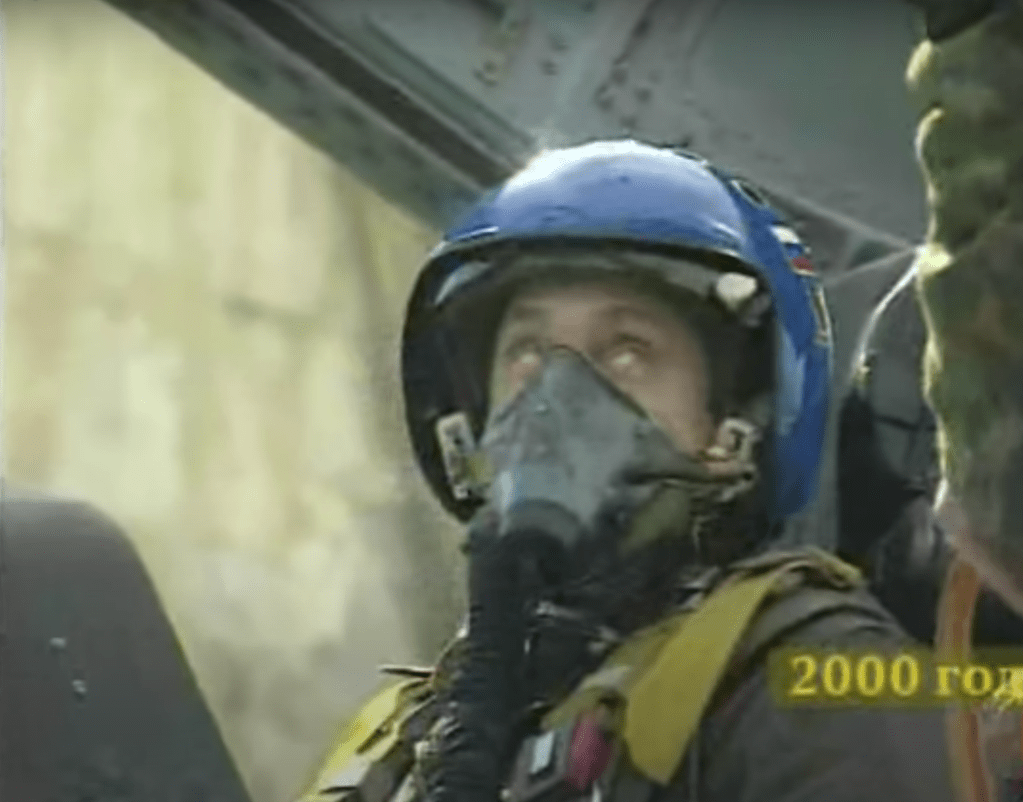
The camera follows Putin during his trips, visits, and meetings, and the film is organized as a whirl of faces and places that Putin walks and works through. This is a series of work trips rather than an election campaign or a promotional tour. The way the film is edited takes you through this non-stop presidential year: catastrophes and terrorist attacks, TV shows, and sparing with kids on tatami mats. Putin is presented as a very active and versatile person: he drives a tractor, flies a plane, tours a submarine, etc. He dares to go to Chechnya and leave flowers where the paratroopers from Pskov died and visits Vedyaevo, the place where the Kursk submariners lived before dying in a tragic accident.
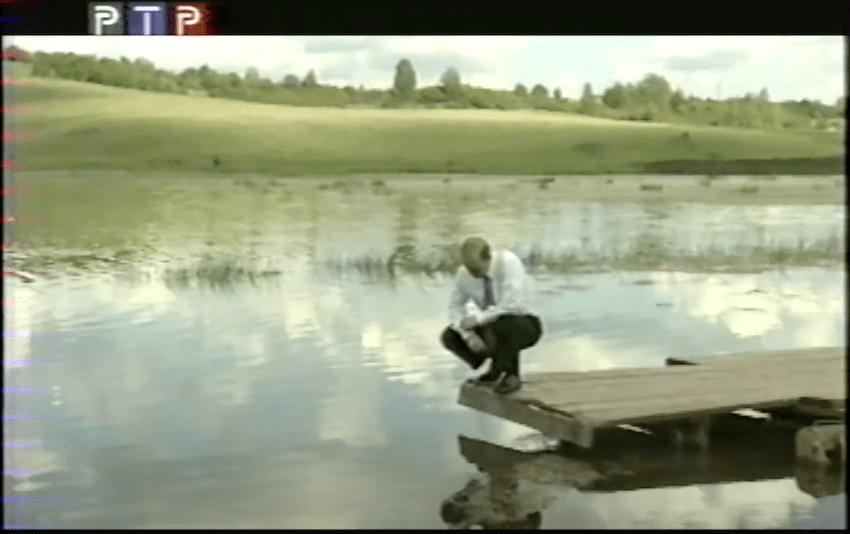
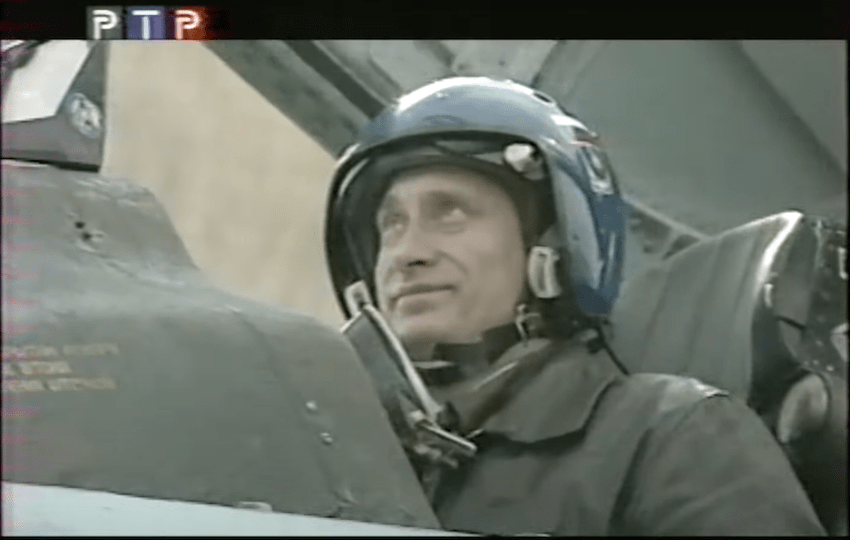
There is Vladimir Putin whose image has not yet been completely formed into the one we know nowadays. It is not yet the image of the Soviet spy Stierlitz from the Soviet TV series “Seventeen Moments of Spring” that is often replicated in recent TV documentaries about Vladimir Putin—an image that seems so close and familiar and yet so distant and strange.

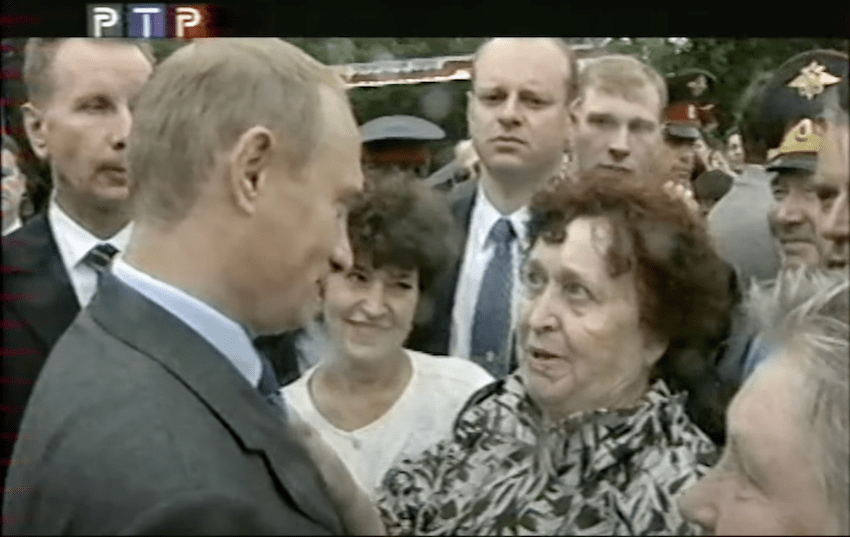
We observe the happy face of the president when he talks to women on the street; we observe his pale and tragic face when he speaks about terrorist attacks; we observe him comforting a random man in the passage under Pushkin Square after the terrorist explosion there. These scenes, as well as the one with Putin cuddling a dog, swimming in his pool, or talking about the impossibility of grabbing a beer like a normal person, shorten the distance to Putin as a personality enormously.

Putin is hugging a man in the passage under Pushkin Square in Moscow after the terrorist attack

Women become an important element of the film’s storytelling: old women in the streets, a young girl with a Pioneer tie, the famous ballerina Maya Plisetskaya, who bows to him on the stage… The old babushkas call him “My boy” and say they trust him.

These women hug him, smile at him, honor him. Then widows of the sailors from the sunk submarine Kursk become a part of the film’s agenda, a silent (in this documentary) symbol of the tragedy within the submarine. In Putin. The Leap Year we often see the President’s wife Ludmila. She appears with him at official meetings, in trips that are left unnamed, walking together and holding hands. It is very rare that such footage is included in documentary films about Putin. In most, the focus remains on his mother and teacher, rather than his wife or daughters.

Vladimir Putin’s personal life in this film appears as a kaleidoscope of family photos, which travel from one documentary to another. Mansky and Putin, in the film, have several conversations that often happen late in the evening. They discuss uncomfortable topics: the possibility of extending the President’s term, life after leaving the presidency, Vladimir Putin’s political views, and his attitude to the Communist past, both his own and that of his country.

Quote from the film:

I have talked quite often with monarchs in various parts of the world during official visits in this last year. And I can say that their fate does not inspire me to repeat something like that because their life is hard, full of limitations. People, they do not belong to themselves and that is their destiny. And this is already forever. In this sense, the life and fate of the elected head of state is, in my opinion, much better, because it gives a person an opportunity and a chance to prove himself in the greatest deed of serving the Motherland, to the maximum. At the same time, it provides an opportunity to live a normal life after fulfilling official duties, after the end of a term of office. However, at the same time, it always reminds him that this period will end someday. And, firstly, it will be necessary to live the life of a normal person and it is necessary, as we used to say, to not be ashamed of the lived years. And so that there was an opportunity in their new position to boldly look people in the eyes, not to look away. And then it is also very important – you need to understand that you will live like a normal citizen. And what you do with the state today, and with society today, you will have to face this in a few years as an ordinary citizen. This is a sufficiently serious incentive to think once more when making decisions and not be guided by monarchist ambitions when making decisions.

Vladimir Putin

Sources:

  1. Tarasov, A. Interview with Vitaly Mansky. Avtorskya programma Alekseya Tarasova. Gost Vitaly Mansky. Efir ot 25.04.2018
  2. Karpenko, M. Filmography of Vladimir Putin. Kommersant. 2018
Director Igor Shadkhan

Chief editor Natalia Zlobina

Executive producers Anna Vinogradova, Aleksandr Makushin

Length: 58 min

Where it was shown: TV Channel Russia (Russia-1 now) 07.10.2002

Personalities shown: Ludmila Putina, George and Laura Bush

Characters: Vladimir Putin, Igor Shadkhan

Film online:

Vladimir Putin. Evening talk [Vladimir Putin. Vecherny razgovor] (2002). Part 1.
Vladimir Putin. Evening talk [Vladimir Putin. Vecherny razgovor] (2002). Part 2.
Vladimir Putin. Evening talk [Vladimir Putin. Vecherny razgovor] (2002). Part 3.

Sometimes the title of this film is translated into English as “A conversation in the Evening” (see e.g., Sakwa, R. (2007) Putin. Russia’s choice; Cameron, R. (2004) Russian Politics Under Putin).

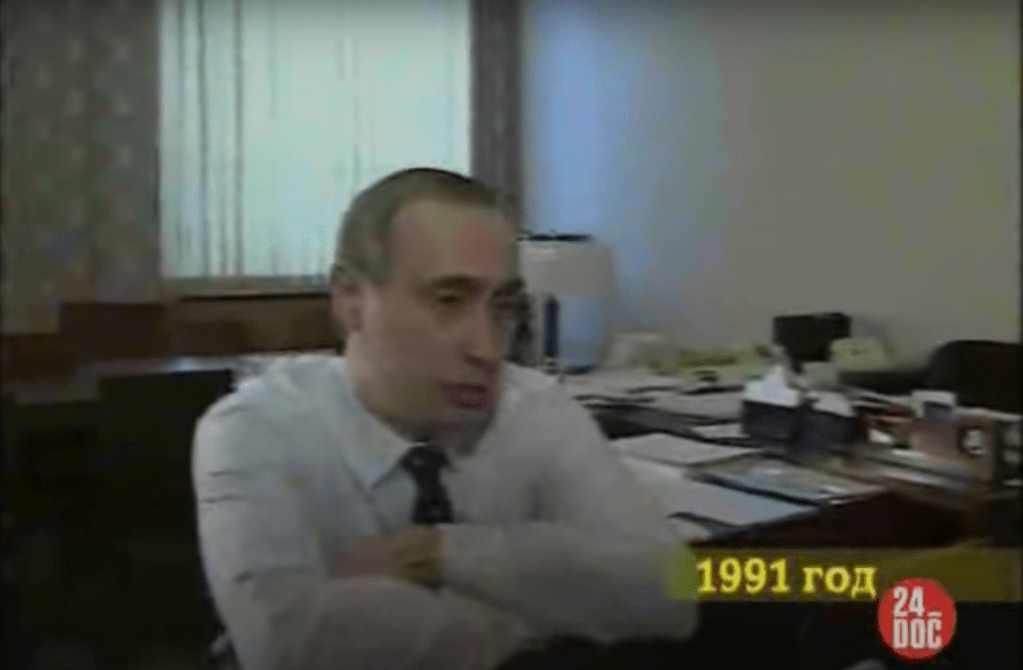
This film is based on the first interview that filmmaker Igor Shadkhan had with Vladimir Putin in 1991. The next year, this interview was shown as a film called Power [Vlast]  (1992). Shadkhan saved all the filmed material. Eleven years later, in 2002, Shadkhan watched the first interview from 1991 with Vladimir Putin and interviewed him again asking the same questions. Shadkhan already had experience filming documentaries about the same characters after a long period of time. He has made several films about Vladimir Putin:

  • Power [Vlast´]  (1992),
  • President´s friends [Druzya presidenta] (1999),
  • Vladimir Putin. Evening talk [Vladimir Putin. Vecherny razgovor] (2002),
  • President’s classmates [Odnokashniki Presidenta] (2004),
  • Your High Loneliness [Vashe Visokoodinochestvo] (2005).

The interview in the film was conducted on the principle of Test for adults [Kontrolnaya dlia vzroslyh] (1977-1992) – in which a character who sees himself on the screen in the past compares and assesses himself in the present.

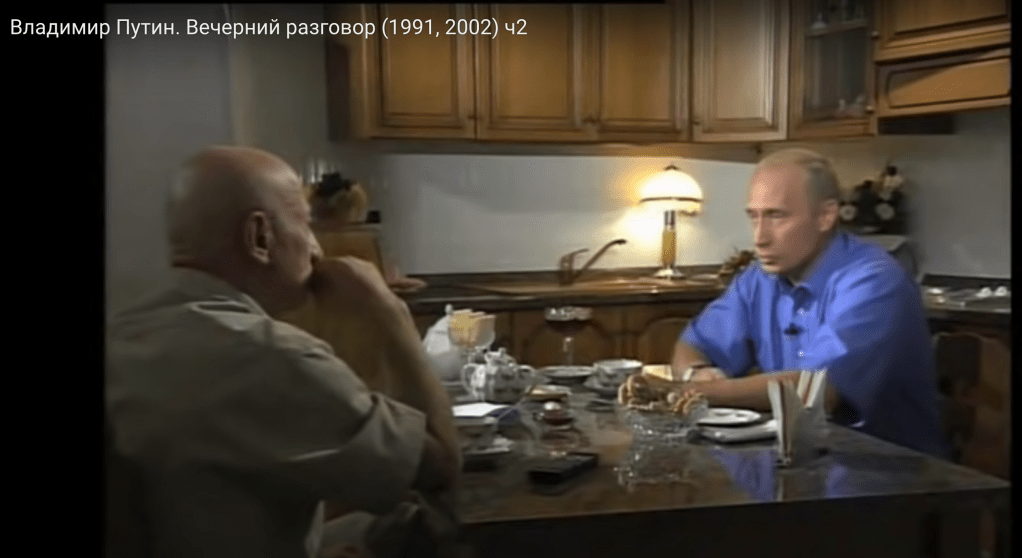
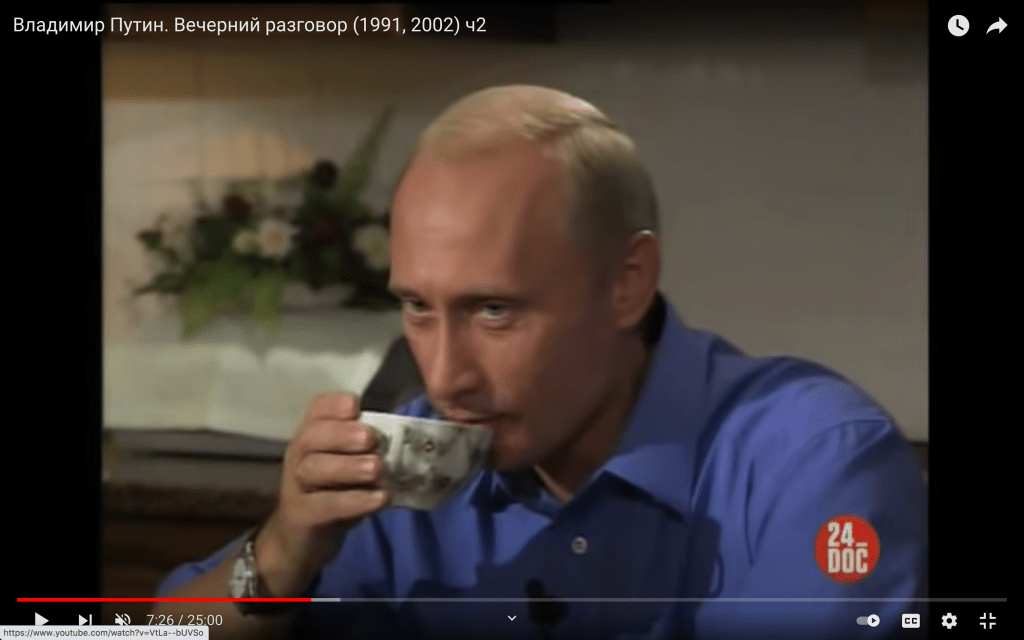
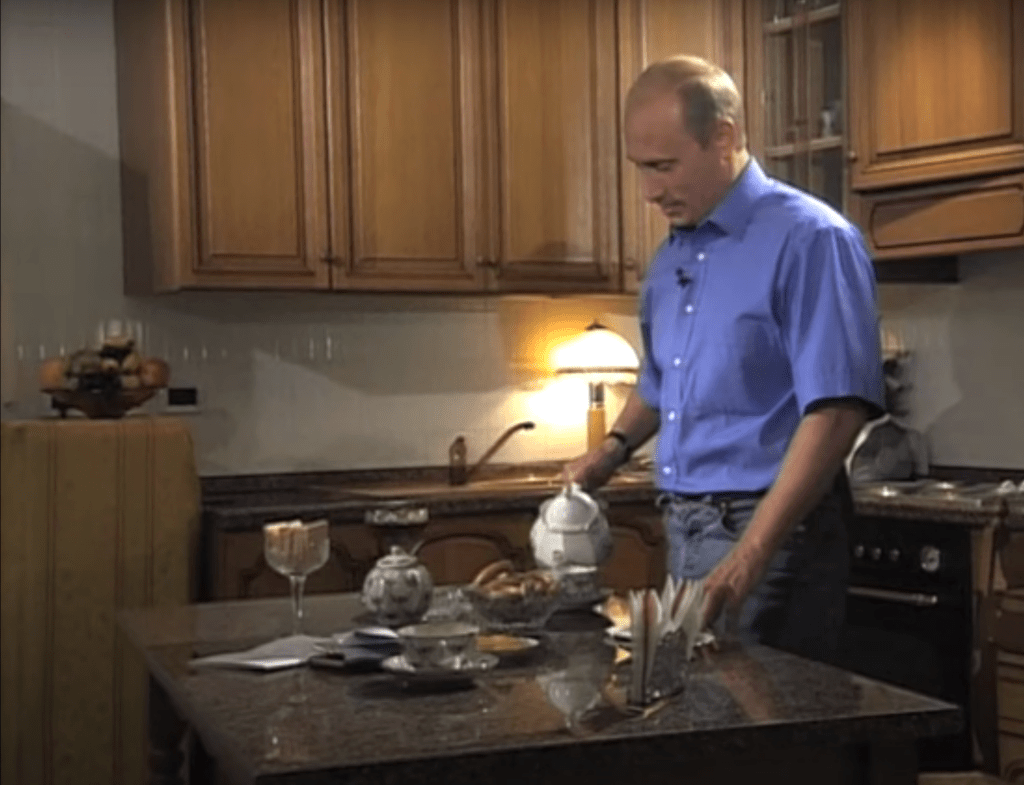
This time he filmed Vladimir Putin in the kitchen of his presidential residence, Bocharov ruchei, in Sochi. Putin prepares tea for Shadkhan in a small kitchen, evoking a scene from an earlier film. In Unknown Putin. Peace and War [Neizvestny Putin. Mir I Voina] (2000), Putin’s assistant at the president’s residence in Moscow made tea for the president, mistakenly giving him a cup with lemon. Putin gives it to film director Vitaly Mansky to avoid wasting it. These gestures with tea humanize Putin and make him look very ‘svoy’ for the Russian audience.
The interview’s setting is very homey. Vladimir Putin is filmed mostly with a middle frame, wearing a blue shirt with short sleeves, sitting in this small brown kitchen. A black dog is yawning next to the table.

They talk about the same issues they talked about in 1991: GULAG, the role of history, and the state of the country. There is a great mise-en-scène: Vladimir Putin with a cup of tea stalks about the necessity of ruling a state with a firm hand; Igor Shadkhan stalks about the GULAG in his calm voice.

Evening Talk. 2002. Putin and Shadkhan sitting at the table with tea. President´s residence in Sochi. Picture 1
Evening Talk. 2002. Putin and Shadkhan sitting at the table with tea. President´s residence in Sochi. Picture 2

The conversation flows from a discussion about Sobchak and politics in Saint Petersburg to international affairs, poverty in Russia, establishing a middle class and taking care of the elderly.

In 1991 the conversation touched on the Soviet period: when Shadkhan notices that the bust of Lenin has disappeared from the shelf in Vladimir Putin’s office during filming Putin says he does not know where it has disappeared to and does not much care. He also mentions that the country has suffered too much and that it was a tragedy that in 1917 the communists divided a united Russia into republics and killed capitalism and the market.

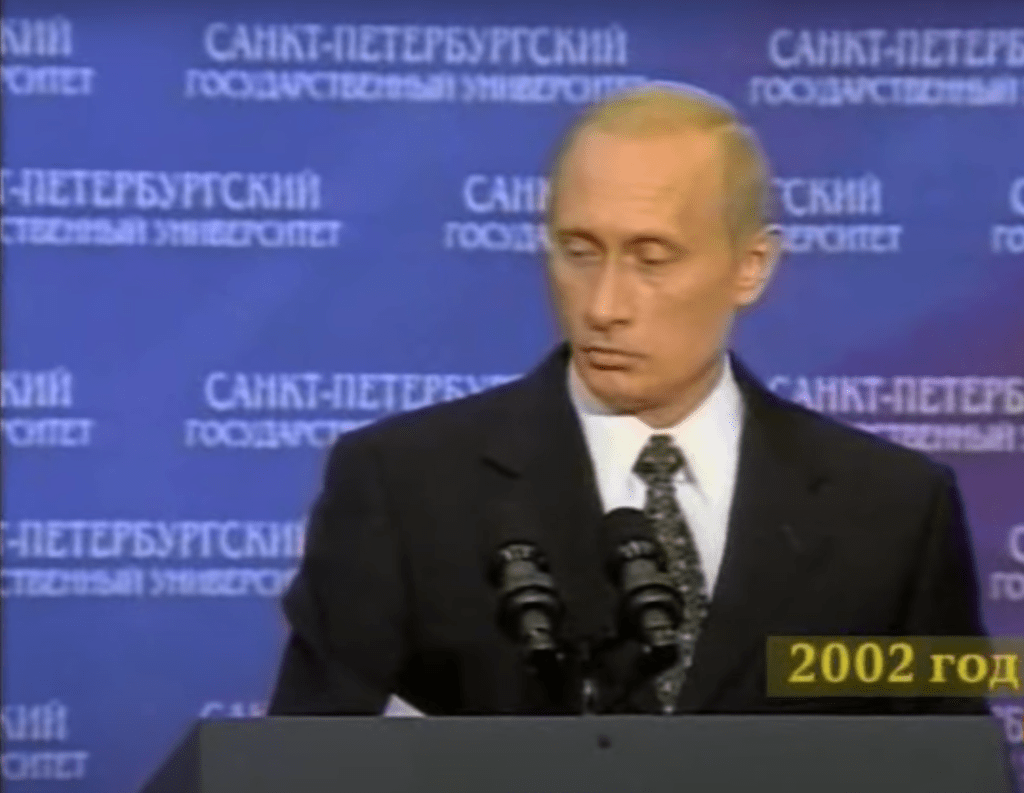
Vladimir Putin talks about his family. This time from the angle of their role in society. He categorizes them as working-class intelligentsia [rabochaya intelligentsia]. They replay Vladimir Putin’s words about his family from 1991, that he has two daughters. In 2002 Shadkhan mentions that Putin’s daughter Masha is already 17 and Katia is 16. They continue a general conversation about young people. They do not particularly mention Vladimir Putin´s wife, Ludmila, but we can see her sitting next to Laura Bush, during the meeting between Bush and Putin at St. Petersburg University in May 2002. Shadkhan asks when Putin was last in a café with his wife, Ludmila Aleksandrovna, where they could dance. Putin answers that he does not remember. He switches the conversation to a patriotic refrain, saying he is not going to complain that he does not have a personal life; he would rather do everything for his motherland.

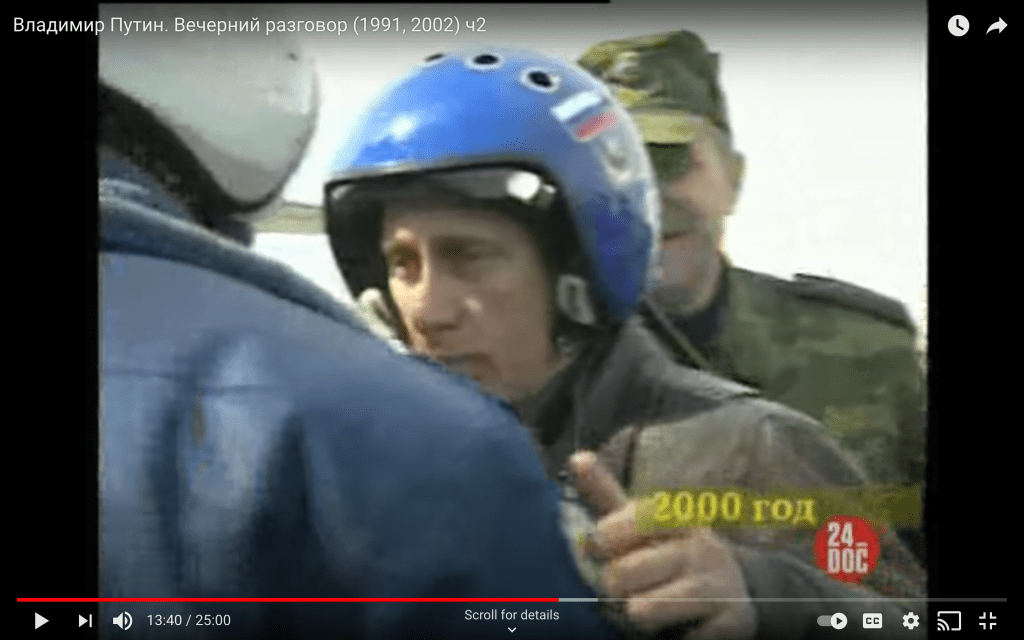
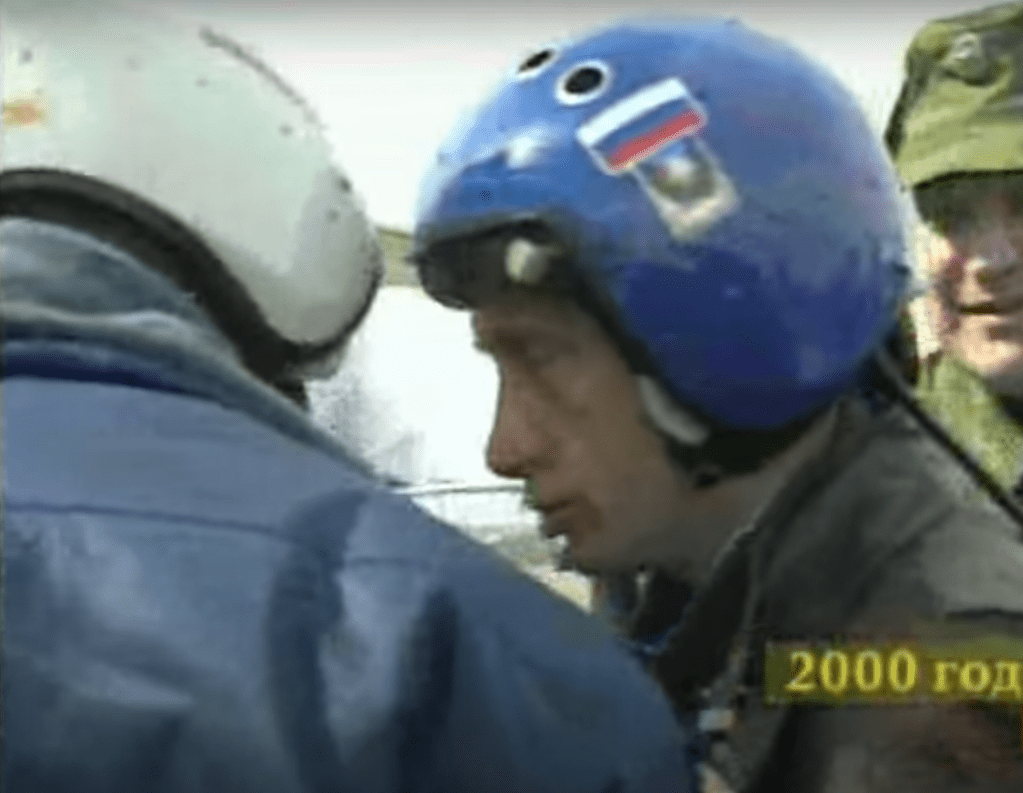
Shadkhan asks Putin’s comments on some of his actions since the last film. For example, when he flew a Su-27 fighter jet to Chechnya. He explained that it happened purely for security reasons. Shadkhan asks about Putin’s trips in Russia, whether they were promotional and whether everything had been prepared in advance to meet the president’s expectations. Putin equivocates. He says that he is trying to visit as much as possible when he is not on holiday.

Allegedly, after they filmed Evening talk Putin asked Shadkhan if he could do something for him, and Shadkhan asked about the amnesty for the heroine of his film I beg your pardon [O milosti proshu] (2001), sentenced to six years for inciting the murder of her abusive husband. The woman was sick, and three children were waiting for her. Moreover, the situation itself was so ambiguous that Shadkhan sided with the woman. A few days later, Putin called Shadkhan and said that a decree had been signed to pardon the heroine of his film.

Quote from the film:

For some people, no matter what they do and whatever they are occupied with, it is never enough power and money. The question is how to dispose of the funds that you have in order to achieve maximum effect. Of course, some kind of standard set of credentials is needed to implement the tasks that face this or that governing body. I think that the Russian head of state has enough such credentials.

vladimir putin

Sources:

1. Karpenko, M. Filmography of Vladimir Putin. Kommersant. 2018

2. Shadkhan N. Rasskazhi pro menya, Igor!: Metod Shadkhana. 2020

3. Shulman A. Kontrlonaya dlya vzroslyh /Test for Adults. Mishpoha-A. 2007

4. Voloshina, V. Ya ne tot pridvorny hudozhnik, kotoriy kosoglazogo imperatora vidaet za yasnogo sokola. Interview with Igor Shadkhan. 2013