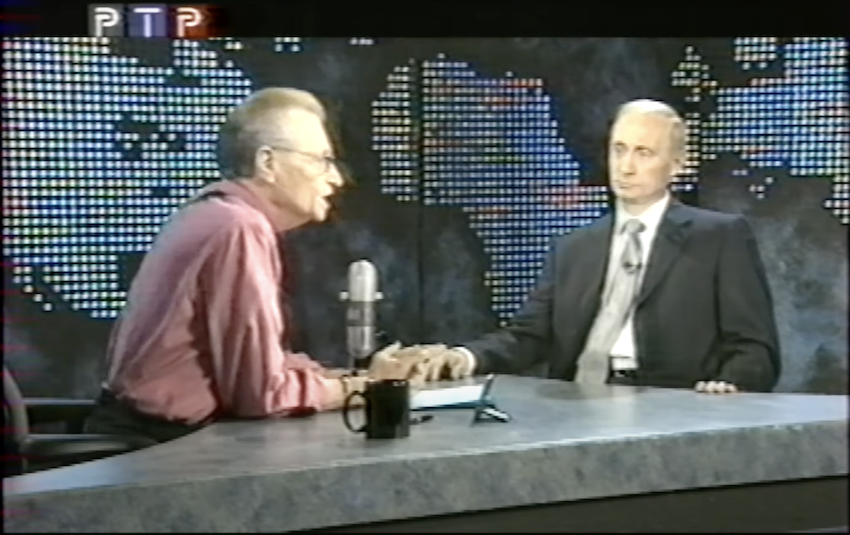
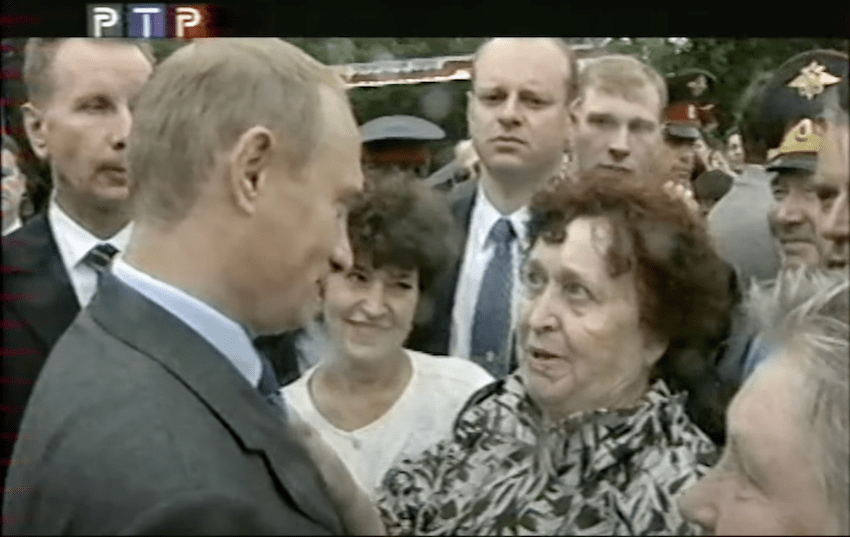
Director Vitaly Mansky; cameramen Yuryi Ermolin, Vyacheslav Sachkov, Alexandr Kuznetsov, Eugeny Sveshnikov, Pavel Sukhov, Sergey Miroshnichenko, Igor Muraviev, Sergey Shishkin, Vitaly Mansky; sound director Lidiya Scherbakova, Alexandr Veselkin; producer Natalia Manskaya

Production: Studio “Vertov &K” ordered by TV Channel RTR
Length: 55 min
Where it was shown: TV Channel RTR (Russia)

Personalities shown: Ludmila Putina, Tony Blair, Maya Plisetskya, Bill Clinton, Gerhard Schroder, Yury Luzhkov, Alexander Lukashenko, Nursultan Nazarbaev, Sergei Shoigu, Patriarch Alexy II, etc.
Characters: Vera Gurevich, Vladimir Putin

Film online (4 minutes):

Excerpt from Putin. The Leap Year (2001).

Putin. The Leap Year [Putin. Visokosny god] was made by Vitaly Mansky with footage from the first year of Putin’s presidency (starting from his first days in the Kremlin when he became the Acting President until May 7th, 2001, the 1st anniversary of his official presidency). It includes some material from Unknown Putin. Peace and War [Neizvestny Putin. Mir I Voina]  (2000). Mansky comments on some of the footage. In 2018, Mansky made another film, Putin’s Witnesses [Svideteli Putina] (2018), where he also uses video from the two earlier films.

The camera follows Putin during his trips, visits, and meetings, and the film is organized as a whirl of faces and places that Putin walks and works through. This is a series of work trips rather than an election campaign or a promotional tour. The way the film is edited takes you through this non-stop presidential year: catastrophes and terrorist attacks, TV shows, and sparing with kids on tatami mats. Putin is presented as a very active and versatile person: he drives a tractor, flies a plane, tours a submarine, etc. He dares to go to Chechnya and leave flowers where the paratroopers from Pskov died and visits Vedyaevo, the place where the Kursk submariners lived before dying in a tragic accident.
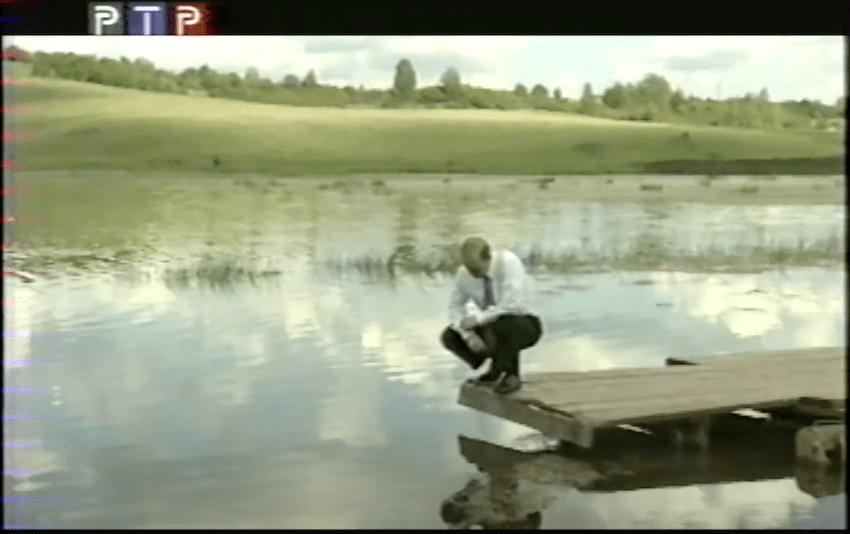
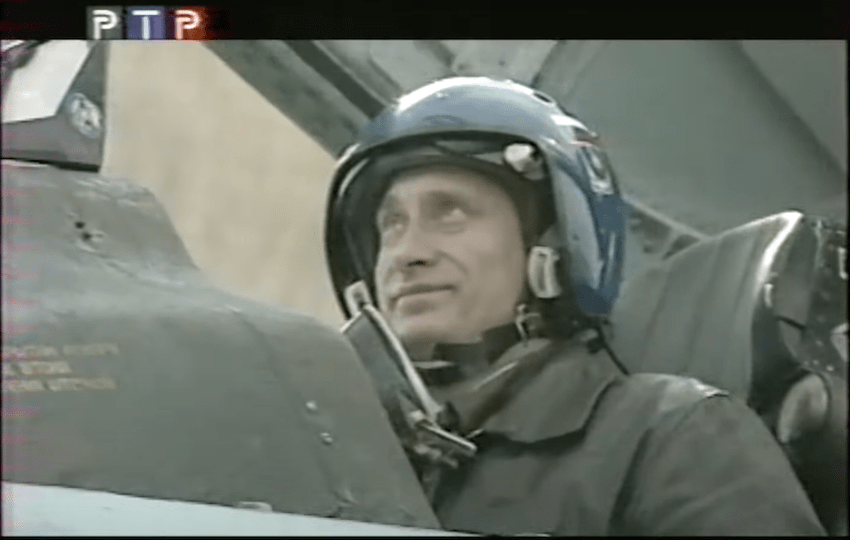
There is Vladimir Putin whose image has not yet been completely formed into the one we know nowadays. It is not yet the image of the Soviet spy Stierlitz from the Soviet TV series “Seventeen Moments of Spring” that is often replicated in recent TV documentaries about Vladimir Putin—an image that seems so close and familiar and yet so distant and strange.

We observe the happy face of the president when he talks to women on the street; we observe his pale and tragic face when he speaks about terrorist attacks; we observe him comforting a random man in the passage under Pushkin Square after the terrorist explosion there. These scenes, as well as the one with Putin cuddling a dog, swimming in his pool, or talking about the impossibility of grabbing a beer like a normal person, shorten the distance to Putin as a personality enormously.

Putin is hugging a man in the passage under Pushkin Square in Moscow after the terrorist attack

Women become an important element of the film’s storytelling: old women in the streets, a young girl with a Pioneer tie, the famous ballerina Maya Plisetskaya, who bows to him on the stage… The old babushkas call him “My boy” and say they trust him.

These women hug him, smile at him, honor him. Then widows of the sailors from the sunk submarine Kursk become a part of the film’s agenda, a silent (in this documentary) symbol of the tragedy within the submarine. In Putin. The Leap Year we often see the President’s wife Ludmila. She appears with him at official meetings, in trips that are left unnamed, walking together and holding hands. It is very rare that such footage is included in documentary films about Putin. In most, the focus remains on his mother and teacher, rather than his wife or daughters.

Vladimir Putin’s personal life in this film appears as a kaleidoscope of family photos, which travel from one documentary to another. Mansky and Putin, in the film, have several conversations that often happen late in the evening. They discuss uncomfortable topics: the possibility of extending the President’s term, life after leaving the presidency, Vladimir Putin’s political views, and his attitude to the Communist past, both his own and that of his country.

Quote from the film:

I have talked quite often with monarchs in various parts of the world during official visits in this last year. And I can say that their fate does not inspire me to repeat something like that because their life is hard, full of limitations. People, they do not belong to themselves and that is their destiny. And this is already forever. In this sense, the life and fate of the elected head of state is, in my opinion, much better, because it gives a person an opportunity and a chance to prove himself in the greatest deed of serving the Motherland, to the maximum. At the same time, it provides an opportunity to live a normal life after fulfilling official duties, after the end of a term of office. However, at the same time, it always reminds him that this period will end someday. And, firstly, it will be necessary to live the life of a normal person and it is necessary, as we used to say, to not be ashamed of the lived years. And so that there was an opportunity in their new position to boldly look people in the eyes, not to look away. And then it is also very important – you need to understand that you will live like a normal citizen. And what you do with the state today, and with society today, you will have to face this in a few years as an ordinary citizen. This is a sufficiently serious incentive to think once more when making decisions and not be guided by monarchist ambitions when making decisions.

Vladimir Putin

Sources:

  1. Tarasov, A. Interview with Vitaly Mansky. Avtorskya programma Alekseya Tarasova. Gost Vitaly Mansky. Efir ot 25.04.2018
  2. Karpenko, M. Filmography of Vladimir Putin. Kommersant. 2018

Uknown Putin. Peace and War.2000. Vladimir Putin is drinking milk in his jet.

Director Sergey Miroshnichenko,

Scriptwriter Vitaly Mansky,

Producer Sergey Miroshnichenko,

Composer Alexander Sidelnikov

Production: Studio Ostrov

Length: 55 minutes

Where it was shown: TV Channel RTR (Russia), Leipzig Film festival (Germany), New York (USA)

Personalities shown: Tony Blair, Sergey Ivanov, Mikhail Shvydkoi, Ilya Klebanov, Valentina Matvienko, Dmitry Kozak, Leonid Reiman, Gleb Pavlovsky, Vladislav Surkov, Boris Eltsin

Characters: Vera Gurevich, Vladimir Putin

Film online (8 min. episode):

This documentary was one of the first films devoted to Vladimir Putin. The film director, Sergey Miroshnichenko, is still one of the most prominent documentary film directors in Russia. Vitaly Mansky, who had worked for state-owned television in Russia, was the scriptwriter for this film. Later, he established the documentary film festival Artdocfest. This festival had to migrate from Russia to Latvia due to political pressure.

One year after Unknown Putin. Peace and War [Neizvestny Putin. Mir I Voina]  (2000) Mansky made Putin. The Leap Year [Putin. Visokosny god] (2001) included material from the earlier film and presented the results of Putin’s first year of presidency. In 2018 Mansky also made Putin’s witnesses [Svideteli Putina] (2008), which likewise uses material from the two previous films.

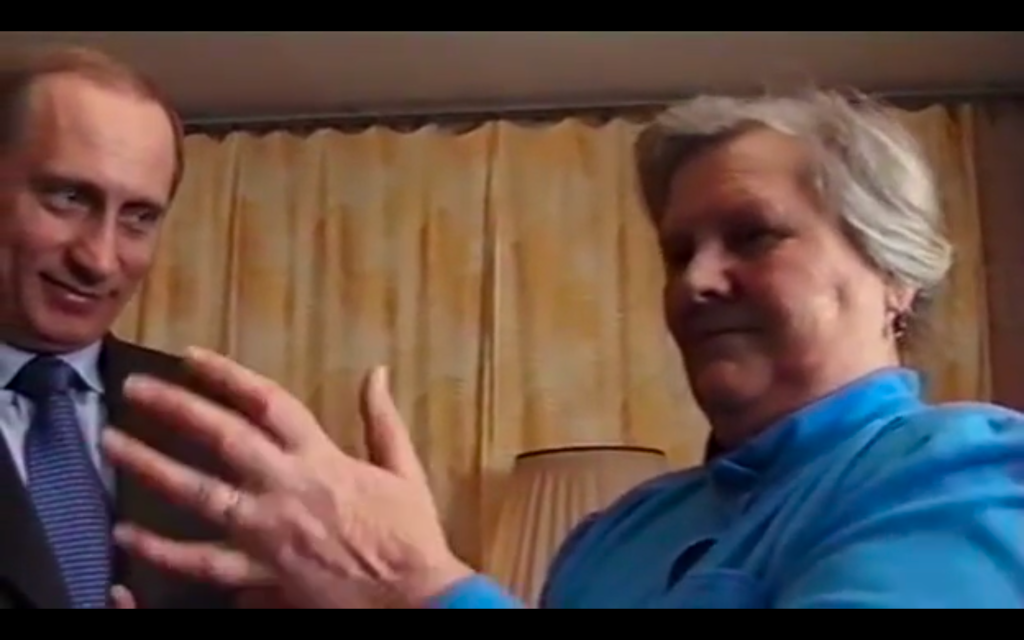
This film about Vladimir Putin is the first one about Putin as the president of the Russian Federation. This starting point shows that Putin is already quite a closed political figure. There are different famous personalities in the film, but they do not speak. A certain level of intimacy is created via interviews with the main character Vladimir Putin. He is the one with the voice, and, as an exception, his schoolteacher in a secondary school, Vera Gurevich who is also at the very beginning of her public role as ‘a teacher of the president’ and a guide to Vladimir Putin’s biography.

With the notable exception of Power [Vlast´]  (1992), this is the first audiovisual evidence of the personality of Putin in the beginning of his career as the highest official in the state. The situation in the country at that moment was shown as tense: terrorist explosions, the war in Chechnya, the struggle for the preservation of national heritage. Vladimir Putin is in the focus. Already in this film, there is only one masculine figure. All the females-like his mother, wife, and daughters-are on the sidelines and shown in photos. His wife, as well as Valentina Matvienko, a Deputy Prime Minister of Russia for Russian Welfare, also appear in an archival video from an official visit with Tony Blair. The documentary starts and ends with the scenes of Putin’s visit to his schoolteacher, Vera Gurevich (later on she will appear in some other documentaries about Putin and will also write a book about him). Already in this film, Putin is presented as a self-sufficient man whose mother/teacher figures and the other women in his life are background support.

Many of the following features will become a trademark for the films about Vladimir Putin, regardless of the personality of the film directors, their nationalities, and even their opinions of Putin.

Among those features is a “unique”—repeated almost in every film—visit to the President’s office in the Kremlin. In Unknown Putin. Peace and War, Mansky visits Putin’s office and asks him whether the president has had a look from the windows in his office. Putin literally looks behind the curtain under the supervision of a camera. All the equipment in the office is left from his predecessor, Boris Eltsin. Putin admits that the computer is his own and he is still learning how to use it.


The time and space of filming Vladimir Putin are often replicated across different films about the president. The interviews are held in the same locations: different rooms in the Kremlin, his office, the president’s residence in Sochi, the president’s airplane, his car. Sports locations: a swimming pool, an ice skating rink, a tatami. Interviews are conducted en route to some other place, in the breaks between meetings, late evenings, even at night. Mansky films Putin in his office in the Kremlin, in his residence near Moscow, in his car. They also show some protests in Moscow, where Putin is not only present but also talking to one of the activists about saving an architectural monument. This latest scene is almost impossible to imagine nowadays.

There is plenty of footage of sorrow and grief that was on the internal political agenda in those days. Mansky filmed Putin’s late-night visits to the monument commemorating the victims who died in the terrorist attacks on Gurianova street in Moscow. The filmmakers included a long piece of footage of the public funerals of the paratroopers (who were killed in Chechnya) at the Pskov Kremlin.

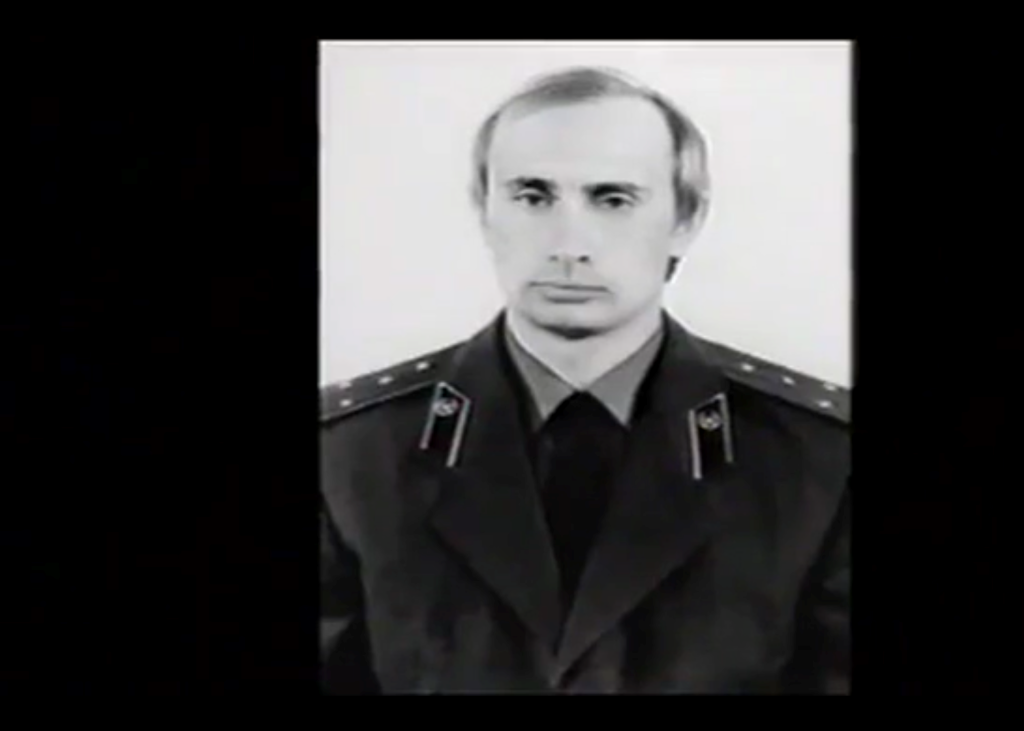
The personal story of Putin is told through photos. These photos, as well as biographical stories, travel from one film to another. From  Unknown Putin. Peace and War we learn some of them: how his mother won their first car in the lottery, how he met his wife Ludmila, about the fire that once happened at his dacha, and how he saved his secretary and his daughter from the fire and others.

Some archival photos from the film:

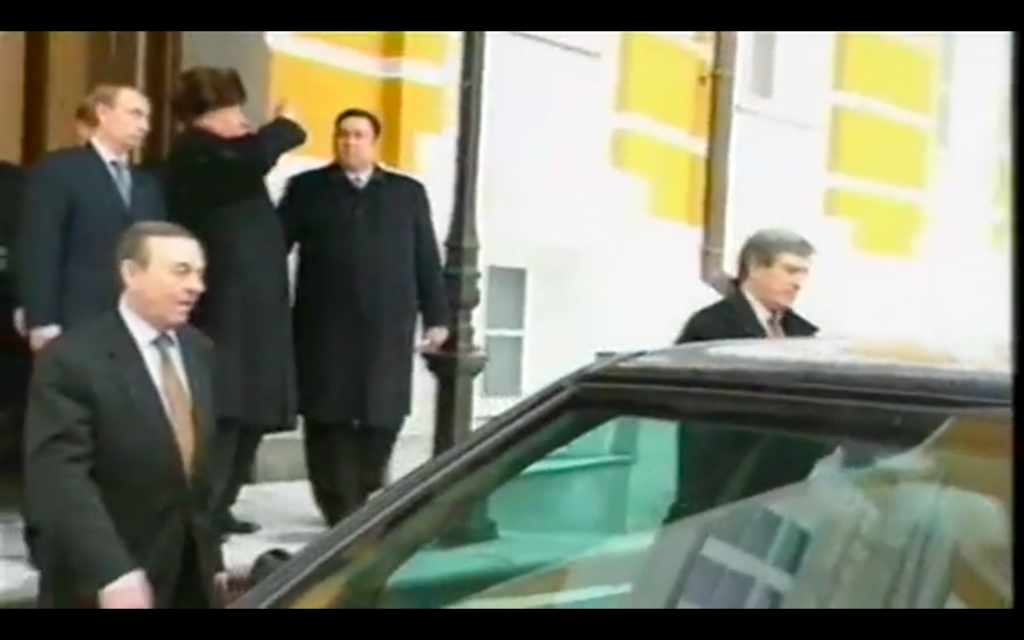
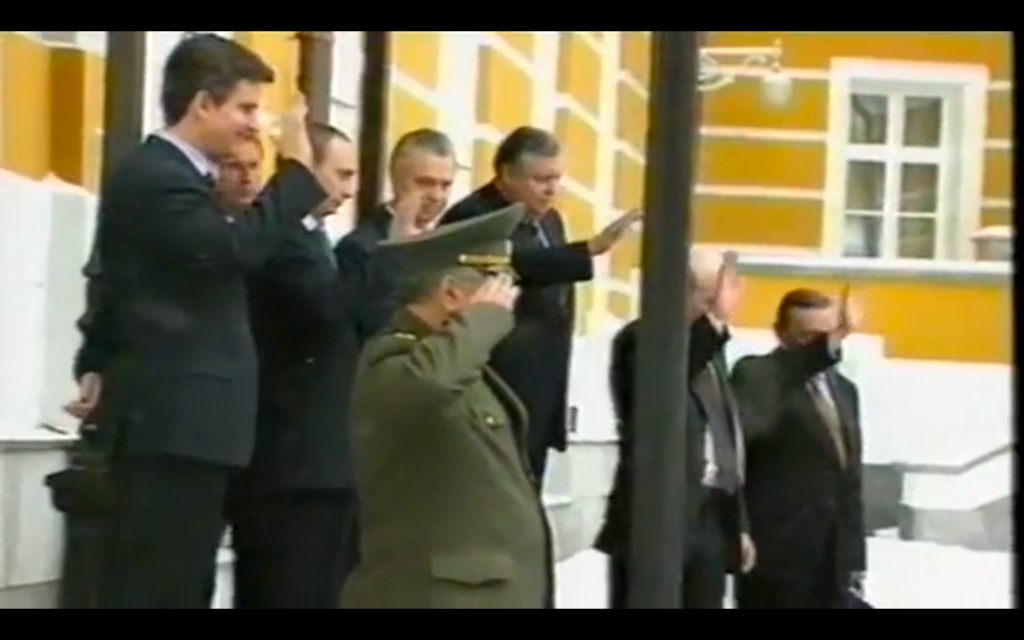
Meanwhile, the history of the country is told through archival video. Symbolically rich is the episode with Boris Eltsin and his departure where Putin and some other politicians close to him are saying goodbye to Eltsin on the porch in the Kremlin.

The authors of this documentary would rather observe Vladimir Putin than attempt to explain things. The latter happens with many of the films about the president. Here, in contrast, only three people do most of the speaking: Putin, Mansky, and Vera Gurevich. Thus, we do not learn much about the president: he likes tea with milk, he used to call his wife when he was going to be late at work, he works out every day, and he is very busy and works until very late.


The observational mode of the film leaves us an opportunity to see an early representation of Vladimir Putin as the president of Russia. As Mansky will explain later (see Putin The Leap Year), he saw Putin as a person who was not used to being on the front page and preferred staying backstage. That is why Mansky jokes that he will give commands to Putin: the director tells Putin where and how to pose in front of the camera. As a result, footage, where photographers ask Putin to pose in front of the camera, creates a very vivid image of a young politician on the new stage of his career as a public figure. Recent documentaries never allowed these kinds of ´liberties´, where Putin is said what he is supposed to do.

Quote from the film:

– Have you settled into the Kremlin?
– Yes, I have!
– How do you like it?
It is comfortable!
– Comfortable? And what about the president’s armchair? How is it?
It fits!

vladimir putin

Sources:

1. Interview Z. Svetova with V. Mansky for OpenRussia (2017)

2. Karpenko, M. Filmography of Vladimir Putin. Kommersant. 2018
3. Interview A. Artukh with V. Mansky for Artterritory (2013)